
-cropped.svg "DataSpring-Logo-RGB-Primary (1)-cropped")
Provider Data, Fixed at the Source

Fix the Source, Not the Symptoms: Why Provider Data Quality Has to Start Upstream
I have spent my career around healthcare data, and I keep watching the same mistake: talented teams, sophisticated tools, applied to the wrong end of the pipeline. The technology for improving provider data has never been stronger. But too often, it is still applied too late — after provider information has already been copied, transformed and separated from its source. That is why patients still struggle to access care, providers are asked to verify the same information again and again, and health plans continue to spend heavily correcting records that keep drifting out of date.
Finding an error is not the same as fixing it. And fixing it in one downstream system does not stop the same error from appearing somewhere else.
That is the quiet flaw underneath years of investment in provider data quality. We have gotten very good at identifying bad data. We have not solved the harder problem: keeping the record trustworthy before it spreads.
THE COST OF A COPY
Two parties, one broken record
Provider data is more than a collection of fields. It is the operational record that helps providers, health plans and healthcare organizations work from the same understanding of who a clinician is, where they practice, what services they provide and how patients can access care.
It supports credentialing, network participation, provider directories, reimbursement, monitoring and the many workflows that depend on accurate provider information across the healthcare system.
When that information is incomplete, outdated or inconsistent, the impact is felt across the ecosystem:
- The practitioner is misrepresented across directories they do not control and often cannot easily correct. They submit the same information repeatedly, watch errors resurface and absorb the consequences when inaccurate data delays payment, disrupts referrals or makes it harder for patients to find them.
- The health plan carries the operational and regulatory exposure. Directory data must be maintained, corrected and defended, often through repeated cleanup cycles that consume time and resources without solving the underlying issue.
- The Patients trying to access care feel the failure as they navigate provider resources. A wrong phone number, an outdated office location or a closed panel can break the journey before an appointment ever happens. Provider data is no longer an operational issue in that moment. It is an access issue.
Powering the Next Era of Provider Data
Enjoying this article? Join DataSpring for an upcoming webinar exploring how more accurate, connected provider data can reduce administrative burden and improve healthcare operations.
Register NowTHE WRONG QUESTION
Accuracy was never the whole problem
The industry has reduced provider data quality to one question: Is this field accurate?
It is a fair question. It is also too narrow.
Four things have to be true at once for a provider record to be trustworthy:
- Accurate — the information reflects reality.
- Complete — the record contains the information the workflow requires.
- Unique — there is one trusted version of the provider.
- Current — the information is still true when it is needed.
None of these qualities is enough on its own. A record can be accurate but incomplete. Complete but duplicated. Unique but outdated. The value comes when all four hold together over time.
For many fields, validation lasts a long time. A verified license number is likely still correct tomorrow.
But some of the fields that matter most for provider directories and patient access change constantly:
- Where a clinician practices
- Whether they are accepting new patients
- Whether they participate in a network
- How patients can reach them
These fields move faster than traditional verification cycles. A clinician changes locations. A panel closes. A phone number routes to the wrong front desk. The record may have been right yesterday and wrong today.
That is why currentness is the real differentiator.
Attestation remains important, especially for credentialing. But attestation is one form of validation, not the whole answer. Keeping provider data current requires continuous validation, enrichment, monitoring and targeted outreach after the initial record is created.
Most of the market competes on pieces of provider data quality. The harder work — and the bigger opportunity — is keeping accuracy, completeness, uniqueness and currentness together in one record over time.
THE PERFECT WORLD
Two incomplete truths, made one
No single source holds the complete provider record.
Providers know things no external source can reliably maintain. Authoritative sources know things providers should not have to validate themselves. Each provides part of the picture. Neither provides the whole picture.
The strongest provider record brings those inputs together. It combines provider-supplied information, authoritative sources and continuous validation into a single record. Intelligence helps reconcile differences, identify anomalies and determine the most reliable source for each field.
Many organizations are investing in similar capabilities: matching, entity resolution, confidence scoring and monitoring. The differentiator is not the presence of those tools. It is where they are used.
Used downstream, they help identify errors in copies of provider data. Used at the source, they improve the record before those errors spread.
THE SHIFT
Stop applying intelligence to a copy of the data, downstream, where the most you can do is flag an error. Apply it at the source, where you can prevent one.
THE SHIFT
Improving provider data starts by changing where the work happens
The better model is simple, even if the work is hard: improve the record once, where the truth originates, and let every downstream workflow benefit.
Provider data falls out of date on its own. Clinicians move, change affiliations, renew licenses, close panels and join or leave networks. A record that was clean last quarter may not be reliable today.
The usual answer is downstream cleanup, with health plans, vendors and internal teams correcting the same records separately in their own systems. That model guarantees repeated work because the source record remains unchanged.
The work moves from many downstream copies to one continuously maintained provider record, validated and enriched where the data originates.
Two ways to run provider data
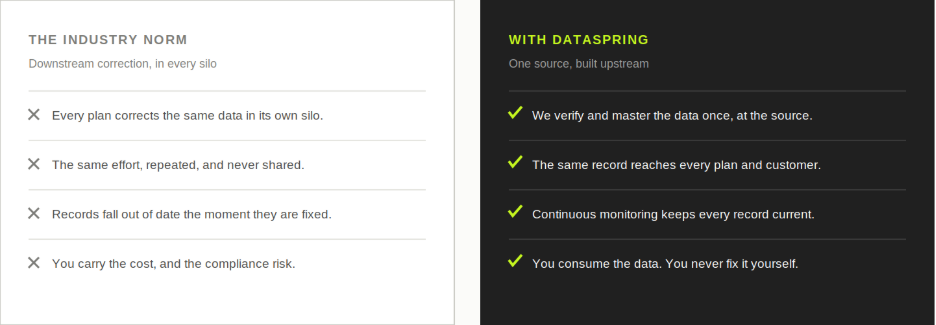
The work moves from many downstream copies to one record, verified and maintained where the data originates.
WHY THIS HAS NOT BEEN DONE BEFORE
The source was always the hard part
There is a reason the industry has spent years cleaning up downstream copies: fixing the source is harder.
It takes several capabilities working together:
- Direct provider engagement at national scale, so provider-supplied information can be collected and maintained.
- Connections to authoritative sources, so identity, licensure, certification, sanctions, enrollment and other critical fields can be validated.
- Continuous enrichment and monitoring, so the record keeps pace with fields that change more often than traditional verification cycles.
- Shared governance, so the record can support multiple workflows and stakeholders instead of serving one isolated use case.
Scale is necessary. It is not sufficient.
Trust comes from the discipline of keeping the record accurate, complete, unique and current as provider information changes. That requires provider-supplied information, authoritative sources, validation, enrichment, monitoring and targeted outreach working together.
The goal is not simply to maintain a larger provider database. It is to create a provider record that becomes more useful as it is maintained — more complete, more accurate and more current over time.
The industry has a measurement problem sitting on top of its data problem. When CMS last conducted a full national review of Medicare Advantage online directories, it found that nearly half of provider locations listed (48.74 percent) contained at least one inaccuracy: a wrong address, a wrong phone number, a provider listed as accepting new patients who was not. Independent analyses since have shown little improvement. Note what those audits measure: downstream copies, the directories assembled after provider data has been duplicated and transformed across dozens of systems.
We measure the source. DataSpring's provider data quality score is a composite of the four dimensions that make a record trustworthy: accuracy, completeness, uniqueness and currentness. Today the source record stands at 82%, improving as the record is validated, enriched and maintained.
|
7.4M+ provider records |
86% of physicians nationwide |
100% national health plan participation |
1,000 health plans and customers build on it |
82%
provider data quality score
|
|
The scale of the source, built as CAQH over 25 years.
ONE RECORD, EVERY STAGE
What a trustworthy source unlocks
Directory accuracy, credentialing, verification and monitoring are often treated as separate problems. They are not. They are different uses of the same provider truth.
When the underlying record is stronger, every workflow performs better.
Directory accuracy becomes less dependent on periodic cleanup. Credentialing and primary source verification can draw on a record that is already more complete and validated. Monitoring can detect change as it happens, not only in the next retrospective sweep.
The long-term value of provider data is not a better database. It is a trusted foundation for the provider data lifecycle — from collection and quality to credentialing, directory management, verification, monitoring and the workflows that depend on them.
A BETTER WAY FORWARD
Prevention instead of correction
Provider data is not solved. But the work is finally moving to the place where it can make a lasting difference.
For years, the industry has tried to improve provider data by correcting copies after they have moved downstream. That model creates duplicated effort for health plans, repeated burden for providers and inconsistent experiences for people trying to access care.
The better path is upstream: one continuously maintained provider information asset, validated through the best available source for each field and improved as the data changes.
The DataSpring source was always here. What is changing is the ability — and the responsibility — to make provider data more accurate, more complete, more current and more useful across the workflows that depend on it.
That is how provider data can deliver value for all.